

At a glance
- Most Canadians (83%) live in major metro areas, concentrating parcel demand in urban corridors.
- Growth is expanding outward into suburbs without reducing density in core delivery lanes.
- Shipping strategies now need to optimize for dense, repeat demand – not just geographic coverage.
Canada’s urban and suburban areas are growing fast. You can see it in busy streets, packed coffee shops, new restaurants, and neighbourhoods that feel more active each time you visit.
The bigger shift, however, is in where parcel demand is building and what is driving it.
For many businesses, urban shipping has long been treated as a tactical decision: a routing choice, a last-mile cost issue, something to optimize once volumes justify it.
That approach no longer fits today’s market.
Across Canada, parcel demand is being shaped by population growth and household formation in the same urban and suburban corridors. More customers are living, shopping and returning packages in these markets, and shipping strategies need to do more beyond keeping pace.
Canada’s urban and suburban growth is a demographic reality, and it is changing how shipping networks need to operate.
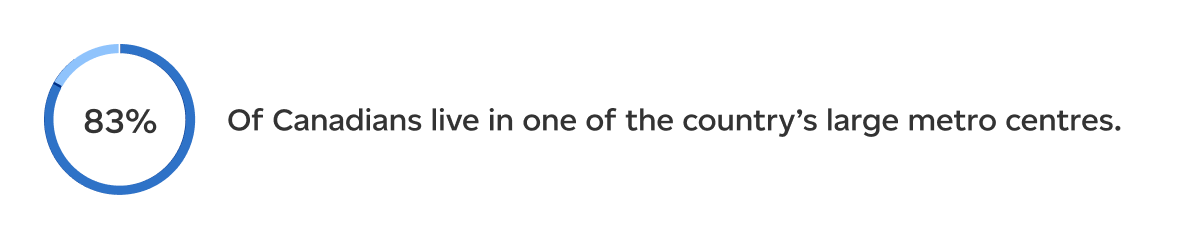
Source: Canada’s large urban centres continue to grow and spread, Statistics Canada, 2022.
Optimize your urban and suburban shipping strategy with Canada Post.
Let’s talkGrowth is concentrating where your customers already are
Canada’s population growth is concentrating in major urban areas and the communities around them. Toronto, Montréal and Vancouver continue to attract a large share of newcomers, young adults and families. At the same time, household growth is strongest in suburban and peri-urban areas within commuting distance of those cities.
Here are three shifts driving this change:
1. Growth is increasingly urban and clustered
Millennials, Gen Z and new Canadians – all groups with higher online purchase frequency and stronger repeat behaviour – are not spreading evenly. They are concentrating within and around major urban areas, driving demand in the same corridors.
2. Household formation is pushing demand into suburbs
Millennials are now forming households in suburbs within driving distance from cities. Yet, their purchasing behaviour remains concentrated. It stays tied to the same urban regions, expanding delivery demand outward while remaining locally dense.
3. Immigration is reinforcing in-city density
New Canadians continue to settle in urban cores and inner suburbs, adding volume to already busy delivery zones and increasing stop density within existing routes.
All this matters because shipping demand follows people, households and repeat purchasing behaviour. Younger adults, new Canadians and family-forming households tend to shop more frequently online and continue ordering over time.
As these groups settle into metro and suburban corridors, they create steady parcel volume in the same lanes many businesses already serve.
For shippers, the message is clear: Growth is showing up inside familiar regions, not in brand-new ones.
Canada’s growing urban areas
Canada boasts 41 Census Metropolitan Areas (CMA), including six with more than one million people.






Source: Census metropolitan area (CMA) and census agglomeration (CA), Statistics Canada, 2022.
Three things for urban and suburban shipping strategies
An urban and suburban shipping strategy starts where demand actually happens – in neighbourhoods, postal codes, building types and corridors.
Here are three things to consider (and a few questions to ask yourself) as you sharpen your view of demand and match service levels to real conditions on the ground.
1. Map volume at the smallest level
Start by reviewing volume by city, postal code and neighbourhood cluster. In dense urban markets, volume often rises in pockets weeks before dashboards reflect a broader trend.
Look for small-but-steady growth in the places you already serve. These shifts can tell you where pressure is building and indicate future capacity needs.
Questions to ask: Where are orders rising fastest? Which lanes carry the most returns? Where are second attempts increasing? Which areas have the highest concentration of repeat buyers?
2. Plan returns like outbound shipping
Returns should be forecasted, staffed and routed with the same care as outbound parcels. If a region generates strong sales, it will likely generate strong returns, too. High-performing regions often generate high return volume as well, putting pressure on the same lanes.
Treat returns as part of your core flow, not an afterthought.
Questions to ask: Which regions generate the highest return volume? Are returns concentrated in the same lanes as outbound shipments? Can returns be consolidated to reduce handling?
3. Review service promises by neighbourhood
A one-size-fits-all delivery promise can be hard to sustain across dense urban areas, suburban crescents and mixed residential zones. Urban routes are also changing as density increases through redevelopment. That makes existing routes tighter, busier and more complex.
Review what you promise customers by local delivery pattern, not only by city name.
Questions to ask: Do all neighbourhoods need the same delivery promise? Where do building type, traffic or access affect performance? Could cut-off times or service options vary by zone?
Top 5 most densely populated downtowns in Canada (residents per km2)





Source: Downtowns in the largest urban centres also have the highest population densities, Statistics Canada, 2022.
How Canada Post can support you
Canada Post helps businesses serve the places where growth is happening now.
That matters when your customers are concentrated in the same regions your business already serves. It means you can work with a network that understands Canadian addresses, supports secure delivery and helps you manage outbound and return shipments with confidence.
Reach that matches Canadian growth
Urban demand is building inside existing metro regions, not spreading into brand-new markets. Canada Post is built to reach those dense lanes, with national coverage that reaches customers across urban cores, suburbs and communities beyond the city centre.
Pricing that is clear and predictable
When shipping volume gets denser, pricing needs to stay easy to plan around. Canada Post offers transparent pricing that helps businesses stay focused on margin, not hidden surprises.
Secure delivery that supports trust
In dense urban markets, delivery security matters. Canada Post’s network supports secure access to millions of Canadian addresses, including apartments, community mailboxes and PO boxes, helping reduce risk and support a better customer experience.
Returns and scale that fit how people shop now
Urban and suburban growth brings more repeat orders and more returns. Canada Post gives businesses a practical way to manage both within the same network, so returns can move with less friction and more consistency. As demand grows, the network is built to scale with it.
Building for a growing market
Canada’s urban areas will keep expanding. Their surrounding suburbs will keep filling in. So will the opportunity for businesses to grow with them.
The businesses best positioned for what comes next will be the ones that understand how demand behaves, where returns are concentrated and how delivery expectations shift across metro areas. They will also be the ones that work with Canada Post, a carrier built to support those realities.
Growth creates complexity and opportunity. An urban and suburban shipping strategy helps you respond to both.
Key takeaways
- Canada’s urban and suburban growth is concentrating demand in the same regions and corridors businesses already serve.
- Urban and suburban shipping pressure builds quietly through more orders, more returns and more delivery complexity in dense areas.
- An urban and suburban shipping strategy, supported by the right carrier partner, helps businesses stay efficient, reliable and ready for growth.
Take a closer look at pricing
Ask a Canada Post representative how to unlock our lowest-ever everyday rates in the urban and suburban markets.
Let’s talk